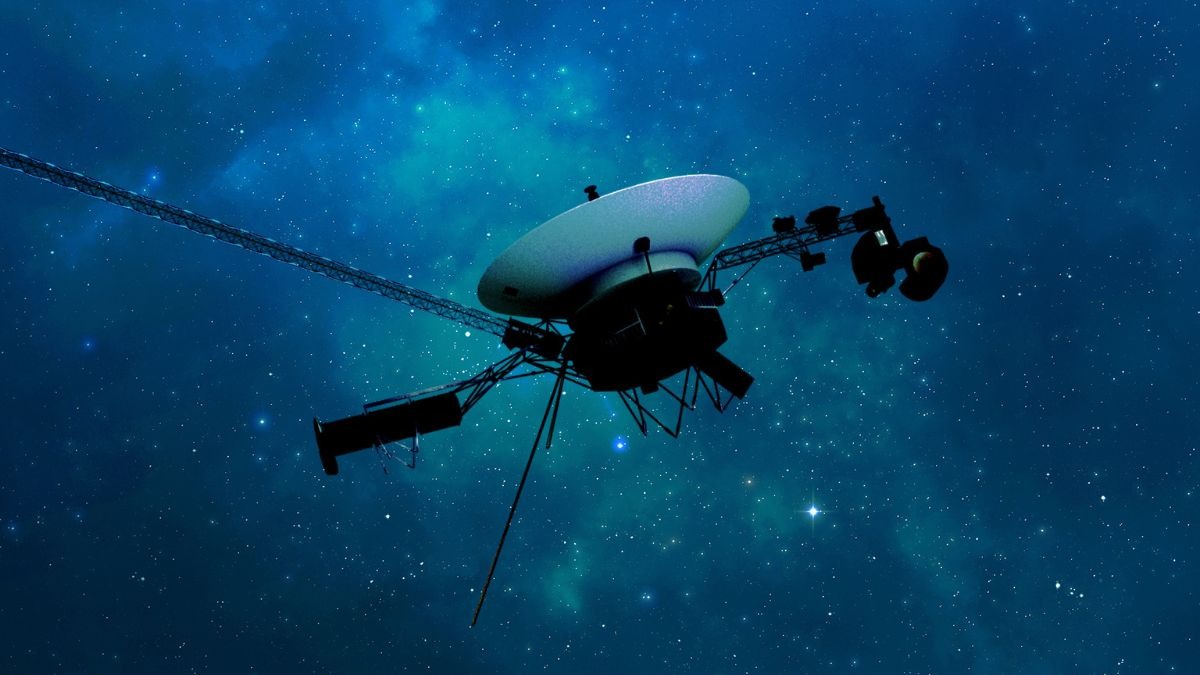
In a groundbreaking development, NASA's Voyager-1 has become the first human-made object to travel one light-day away from Earth, marking a significant milestone in space exploration. Meanwhile, its twin spacecraft, Voyager 2, is still several billion kilometers closer to our planet and yet to achieve the same feat. As per NASA's latest tracking data, Voyager-2 currently stands at approximately 21.7 billion kilometers from Earth, while Voyager-1 is at 25.9 billion kilometers. This places Voyager-2 about 4.2 billion kilometers behind its twin in their journey into deep space. A radio signal takes around 20 hours and 6 minutes to reach Voyager 2, compared to approximately 24 hours for Voyager-1.
Voyager-2's closer proximity to Earth is due to its different route through the solar system. Launched on August 20, 1977, it visited Jupiter, Saturn, Uranus, and Neptune, making it the only spacecraft to have visited all four giant planets. This detour resulted in a different trajectory from Voyager-1, which took a shorter route towards interstellar space after its encounters with Jupiter and Saturn. The two spacecraft also travel at different speeds and in different directions, contributing to their diverging distances from Earth.
NASA estimates that Voyager-2 will travel one light-day away on November 1, 2035, nearly nine years after Voyager-1. Both spacecraft have crossed the heliopause, the outer boundary of the Sun's protective bubble of particles and magnetic fields, and are now traveling through interstellar space. Despite being in space for nearly five decades, both probes continue to send valuable scientific information back to Earth, providing scientists with precious insights and data to study the realms between the stars.