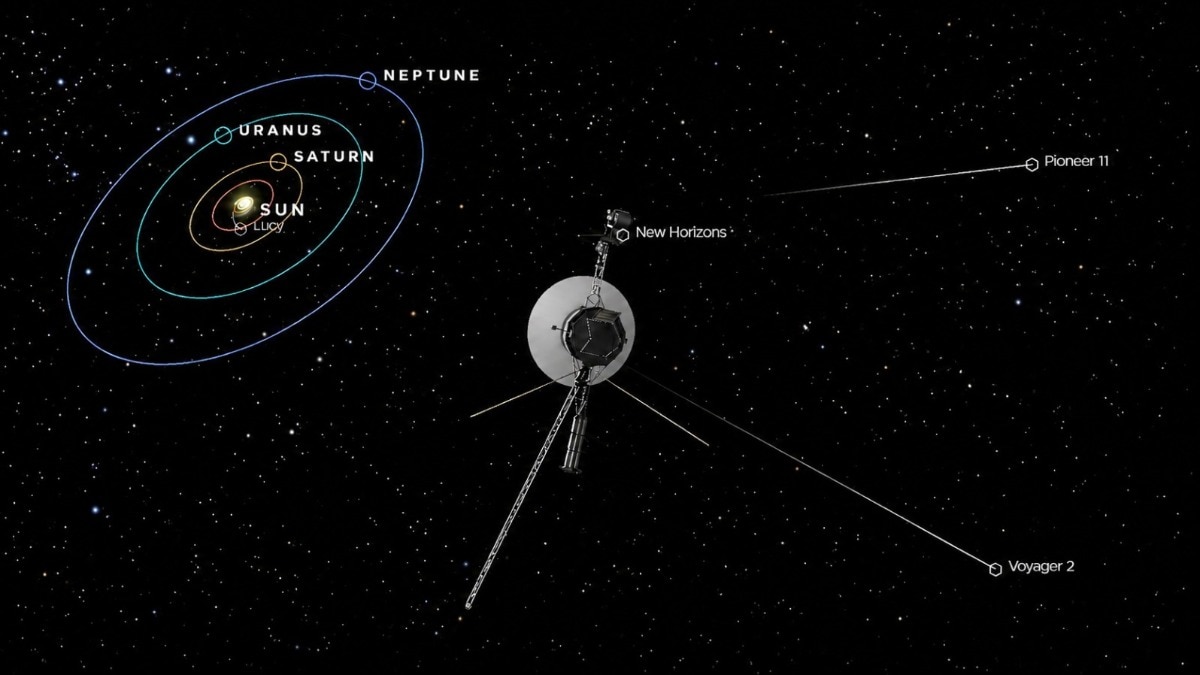
NASA's Voyager 1, a spacecraft launched in 1977 to explore the outer reaches of our solar system, has become the first human-made object to travel beyond one light day from Earth. This means it is now approximately 25.9 billion kilometers away and commands sent from Earth would take more than 24 hours to reach. Launched on September 5, 1977, Voyager 1 was designed to study Jupiter and Saturn. It took images of our solar system that led to the creation of its famous "family portrait." One of its most iconic photos, taken in 1990, shows Earth as a tiny speck known as the Pale Blue Dot. Carl Sagan, who proposed the idea for this image, believed it underscored humanity's responsibility to preserve and cherish our planet. Voyager 1 entered interstellar space in August 2012 and is now 26 billion kilometers from Earth, a distance so great that Earth will no longer be visible from its position. To celebrate this historic milestone, NASA encouraged people worldwide to send signals into the sky, marking Voyager 1's groundbreaking journey.
In an extraordinary achievement, NASA's Voyager 1 spacecraft has traveled farther than any other human-made object, reaching a distance of one light day or approximately 25.9 billion kilometers from Earth. This means that signals sent from Earth would take more than 24 hours to reach the spacecraft. Launched in 1977, Voyager 1 was designed to explore Jupiter and Saturn. It captured images of our solar system that were used to create its famous "family portrait." One of these images, taken in 1990, depicted Earth as a tiny speck called the Pale Blue Dot. Carl Sagan, who proposed this image, saw it as a reminder of humanity's responsibility to care for our planet. Voyager 1 entered interstellar space in August 2012 and is now so far away that Earth can no longer be seen from its position. To celebrate this remarkable achievement, NASA urged people around the world to send signals skyward, commemorating Voyager 1's unprecedented journey.
NASA's Voyager 1 spacecraft has made history by traveling beyond one light day from Earth, placing it approximately 25.9 billion kilometers away. This means that signals sent from Earth would take more than 24 hours to reach the spacecraft. Initially launched in 1977 to study Jupiter and Saturn, Voyager 1 has captured images of our solar system that were used to create its iconic "family portrait." One of these photos, taken in 1990, showed Earth as a tiny speck known as the Pale Blue Dot. Carl Sagan, who proposed this image, believed it underscored humanity's responsibility to preserve and cherish our planet. Voyager 1 entered interstellar space in August 2012 and is now so far away that Earth can no longer be seen from its location. To honor this remarkable achievement, NASA encouraged people worldwide to send signals into the sky, acknowledging Voyager 1's extraordinary journey.