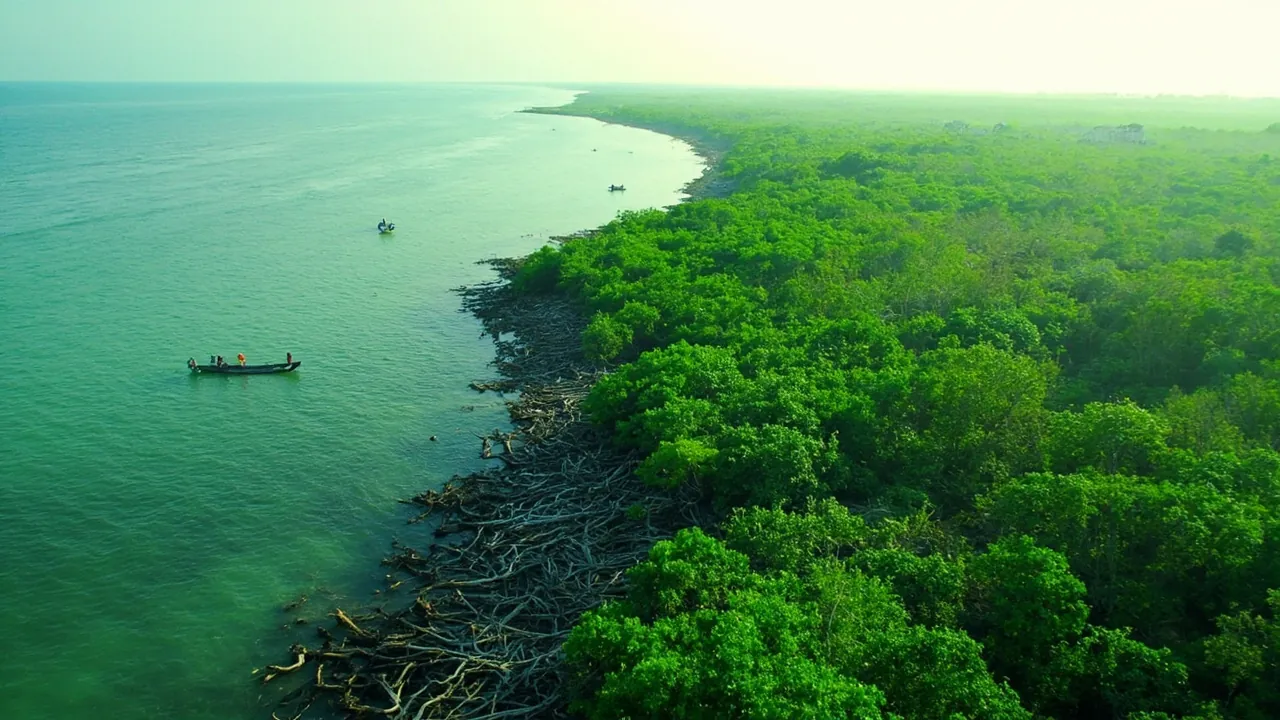
A groundbreaking study by researchers at Tulane University reveals a global resurgence of mangrove forests after decades of decline. The study, published in Science, indicates that the world's coastal ecosystems are no longer losing mangroves at an alarming rate due to deforestation and coastal development. The recovery is primarily attributed to natural regeneration and expansion into newly formed coastal areas. This turnaround offers hope for climate action as mangroves play a crucial role in protecting coastlines, supporting fisheries, and helping slow climate change.
Zhen Zhang, the lead author of the study and a postdoctoral scholar at Tulane University School of Science and Engineering, stated that this is a significant turning point for mangroves, emphasizing their resilience and potential as a powerful nature-based solution for climate mitigation and coastal protection. The researchers found that while mangroves lost nearly 2,900 square kilometres between 1984 and 2010, gains have outpaced losses since then, with an increase of almost 2,000 square kilometres after 2010. By 2023, the net decline over the full four decades had shrunk to about 1 per cent, a much smaller loss than earlier estimates suggested.
Daniel Friess, Cochran Family Professor of Earth and Environmental Sciences at Tulane and director of The Mangrove Lab, explained that this shift is evident worldwide, with mangroves now showing a net increase globally, and the rate of degradation slowing. While some mangroves are still being lost, this recovery could make them a rare conservation success story and an important source of optimism for climate action. The researchers also noticed that many existing mangrove forests are becoming denser and healthier over the past four decades, with closed-canopy forests expanding globally, offering better protection to coastlines and storing more carbon.
However, the researchers emphasized the importance of consistent protection to sustain this regrowth. They stressed that stopping deforestation is essential to prevent large amounts of long-stored carbon from being released into the atmosphere. Additionally, maintaining sediment flow is critical for creating conditions conducive to mangrove growth and expansion, particularly in river deltas where sediment creates good growing conditions. As countries invest in nature-based solutions to climate change, mangroves stand out as a rare example of an ecosystem where global trends are beginning to move in the right direction.