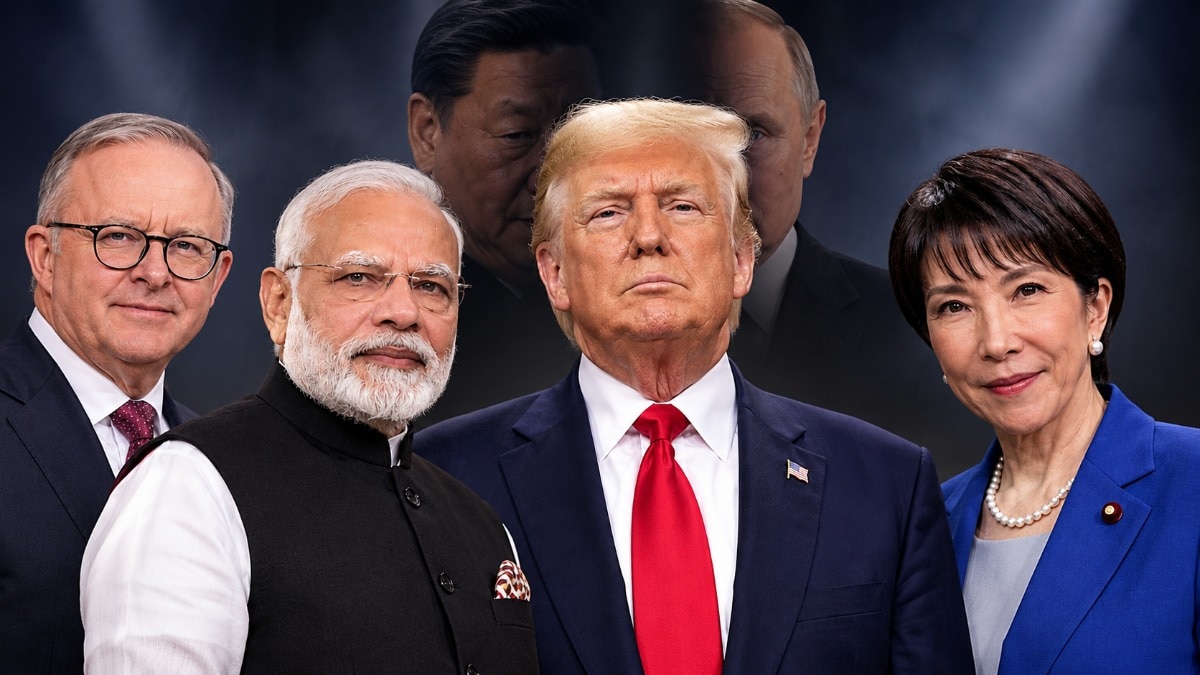
In a sudden turn of events, leaders from the United States, India, Japan, and Australia are scheduled to meet for just 55 minutes at a Quad summit in Manila. This brief meeting comes as US President Donald Trump prepares for extended talks with Chinese President Xi Jinping and Russian President Vladimir Putin, raising questions about Washington's commitment to the Indo-Pacific grouping. Strategic affairs expert Brahma Chellaney has suggested that the Quad is losing its strategic relevance due to the Trump administration's shifting Indo-Pacific approach and accommodative policy towards China. The timing of these meetings highlights the potential diminished importance of the Quad, as it appears that US political attention may be prioritized elsewhere.
On the sidelines of the Manila engagements, Prime Minister Narendra Modi is also expected to meet with President Trump, marking their first interaction in five months. The Quad was revived in 2017 under Trump's presidency, but disagreements over trade, tariffs, immigration, and strained US-India ties have hindered its progress. With Biden's focus on the Quad during his tenure, it is unclear whether Trump will continue to prioritize this grouping as a central pillar of his Indo-Pacific strategy.
The significance of the Quad Manila summit lies in what it represents for a grouping that has struggled to maintain political momentum under Trump. Comprising India, the United States, Japan, and Australia, the Quad was initially formed to address concerns about China's military and economic expansion. While the foreign ministers have continued meeting and cooperation has moved forward in areas such as energy supply chains, port infrastructure, and maritime surveillance, the absence of regular leaders' engagement has raised speculation about the political commitment behind the grouping.
The Quad was never intended to be just another diplomatic forum; its importance lies in bringing together four democracies with significant economic, technological, and military capabilities to preserve a free and open Indo-Pacific. Although its members have maintained that it is not directed against any particular country, China's expanding footprint has been a central factor behind its formation and revival. Beijing has consistently viewed the grouping with suspicion, particularly as the Quad has expanded cooperation beyond infrastructure, vaccines, climate change, and disaster response to maritime security, naval coordination, and critical technologies.
For India, this evolution is particularly significant due to China's aggressive maneuvering along the Line of Actual Control (LAC), its expanding presence in the Indian Ocean Region (IOR), and its growing influence across India's strategic neighbourhood. The Indo-Pacific balance of power has become a direct national security concern for India, making the future of the Quad an important consideration. However, the biggest uncertainty surrounding the Quad is whether Washington continues to view the grouping as strategically relevant in light of Trump's shifting foreign policy priorities.