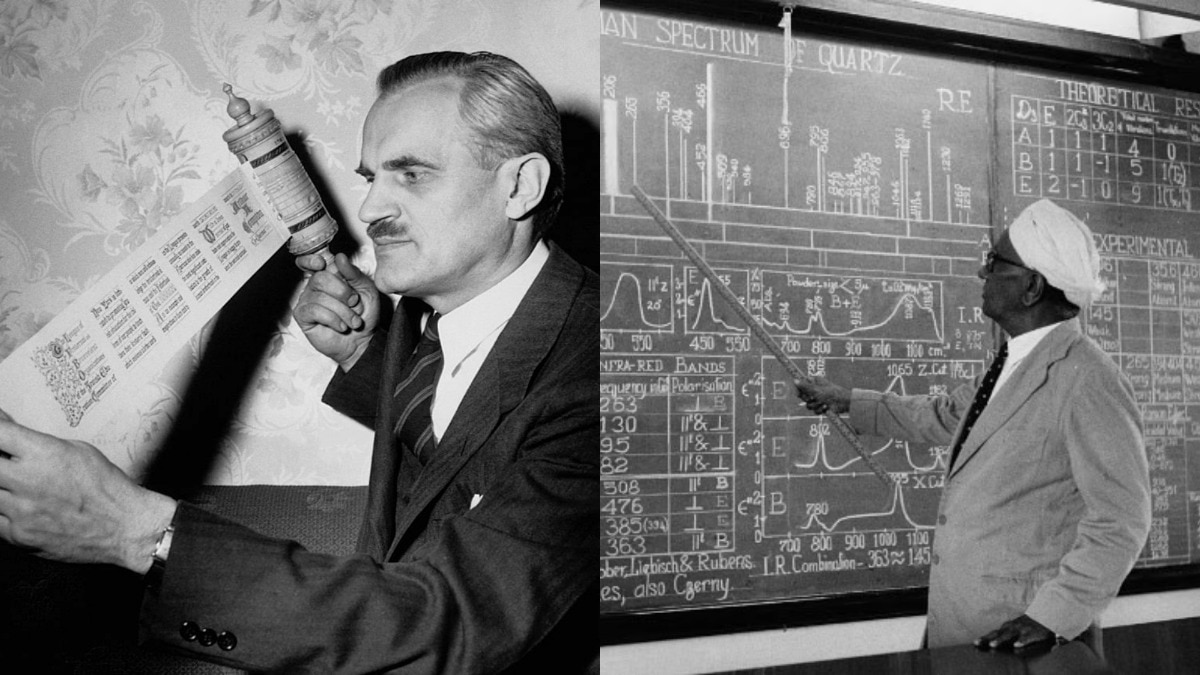
In 1926, American physicist Arthur Holly Compton arrived in Calcutta on a mission to investigate cosmic rays, a mysterious radiation from space. Faced with the challenge of lacking the necessary equipment, he sought help from Indian physicist CV Raman. In an unexpected turn of events, they improvised an electroscope using a hookah bowl - a common household item in India. This innovative solution led to groundbreaking experiments that shed light on cosmic rays. Compton's work, later recognized with the Nobel Prize in Physics in 1927, marked a significant milestone in scientific history.
Compton's journey took him from Calcutta to Lahore, where he spent the academic year of 1926–1927 at the University of the Punjab. His stay brought him into contact with Indian scientist Shanti Swarup Bhatnagar, who was conducting research at a time when India's scientific institutions were striving for international recognition. Together, they embarked on an expedition to Kashmir to investigate cosmic rays further.
Their journey from Lahore to the Himalayas led to a series of groundbreaking observations. The team, which included Bhatnagar and other Indian scientists, used instruments to measure cosmic radiation at different depths in a lake at an altitude of approximately 17,000 feet. Their findings were later documented by Norah Richards in her 1948 account, "Life and Work of Sir SS Bhatnagar."
Through this series of events, a hookah bowl became part of a scientific instrument, leading to significant discoveries about cosmic rays. The story connects CV Raman's laboratory in Calcutta, Compton's investigations into cosmic rays, and Bhatnagar's work in Lahore. This episode is a crucial part of India's science history, as detailed in Edward B Davis' 2009 account in Perspectives on Science and Christian Faith.