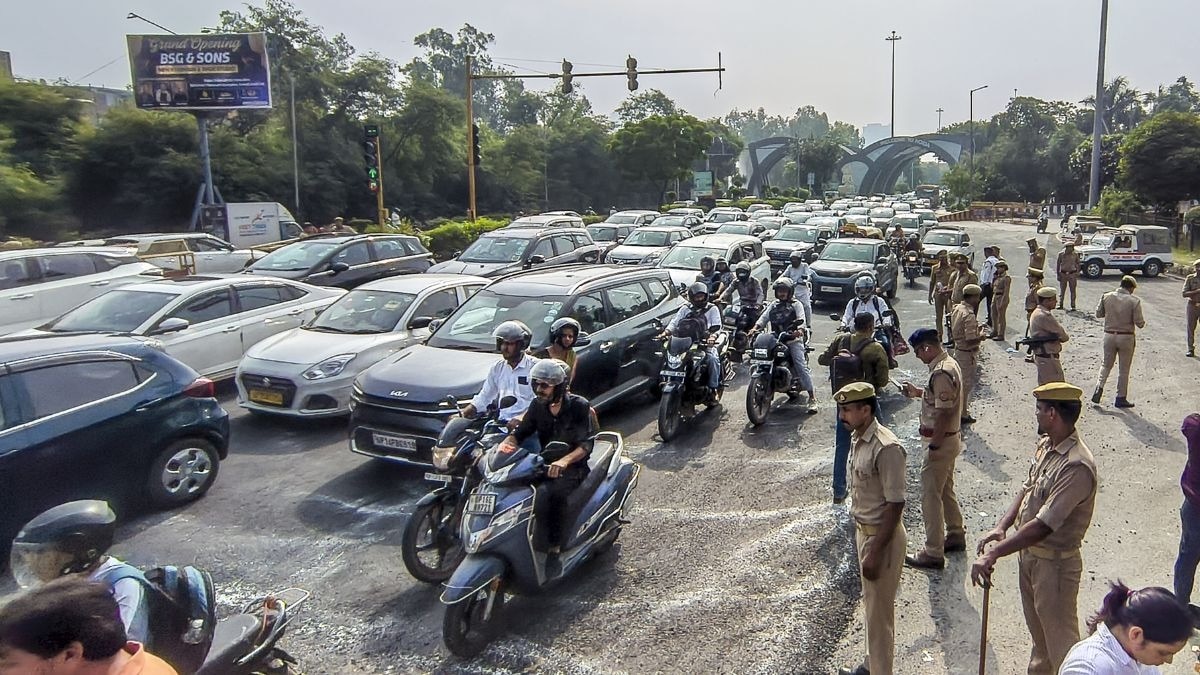
In an unprecedented crackdown on air pollution, the Delhi government fined over 25,000 vehicles lacking valid pollution certificates and turned away nearly 31,000 non-BS-VI compliant vehicles in the first half of November. The stringent measures were enforced during a meeting chaired by Chief Minister Rekha Gupta amidst a surge in winter pollution.
The enforcement data revealed that between November 1 and 17, authorities fined 25,610 vehicles for lacking valid pollution under control certificates, inspected over 180,000 non-Delhi vehicles that did not meet BS-VI standards, and issued fines totaling Rs 5.42 crore. Of these, 30,742 vehicles were turned back, while 2,817 were fined and 189 were seized.
The government also stepped up actions against polluting industrial units and violations at construction sites. Between January and November 16, authorities seized 41,659 old and polluting vehicles, while 64,800 vehicles were scrapped. The chief minister's office announced plans to introduce a barrier-free electronic monitoring system at 154 entry points into Delhi to prevent non-compliant vehicles from entering the city.
Environment Minister Manjinder Singh Sirsa reported that pollution-control efforts had shown positive results, and the government aimed for a 10-15% reduction in pollution annually. The meeting also addressed compliance with rules on systems used to continuously monitor industrial emissions and devices used to control air pollution. Seventy-six industrial units have installed air pollution control devices, of which 75 have been certified as meeting the prescribed standards.
The government directed officials to increase surveillance at entry points and make better use of technology to prevent non-compliant vehicles from entering Delhi. Work has been assigned to introduce a barrier-free electronic monitoring system at 154 entry points into Delhi, covering 20 major toll points, including nine national highways. The chief minister also ordered officials to speed up work to expand parking facilities.
The measures are part of a broader strategy to combat air pollution across sectors, with officials directed to regularly inspect pollution hotspots, strengthen dust-control measures at construction sites, improve road cleaning, expand public transport, and speed up the shift to cleaner vehicles. Between November 1 and 17, authorities inspected 8,874 construction and demolition sites and found violations at 554 locations. Closure orders were issued to 112 sites, while 462 show-cause notices were served and environmental compensation of more than Rs 2.65 crore was imposed.
The government also directed the prompt installation of green nets, barricades, and barriers to control wind and dust at construction sites. Delhi requires 171 large and medium mechanized road-sweeping machines, but only 108 are currently available, with 70 more being deployed. The Municipal Corporation of Delhi is also procuring machines with a capacity of 1,000 liters. Of these, 600 are expected by December 2026, and the remaining machines by January 2027.
The number of anti-smog guns, water sprinklers, and road-sweeping machines has increased compared to last year. The Delhi Metro has been directed to regularly operate anti-smog guns and mist-spraying systems between 7 pm and 11 pm. The government plans to add 2,395 electric buses to the public transport fleet this year, aiming to increase the total bus fleet to 7,680 by the end of the year. Between January and October, 6,000 electric vehicle charging points were installed, taking the city's total network to 14,913.
Under the Parivartan scheme, the government aims to encourage 78,112 polluting goods vehicles to switch to cleaner alternatives. As of November 17, 28,995 vehicles had been registered under the scheme, including 25,737 trucks and 3,258 buses. Electric light goods vehicles are eligible for purchase subsidies of up to Rs 1 lakh. Owners who scrap BS-IV light goods vehicles can also receive a scrapping bonus of Rs 50,000.