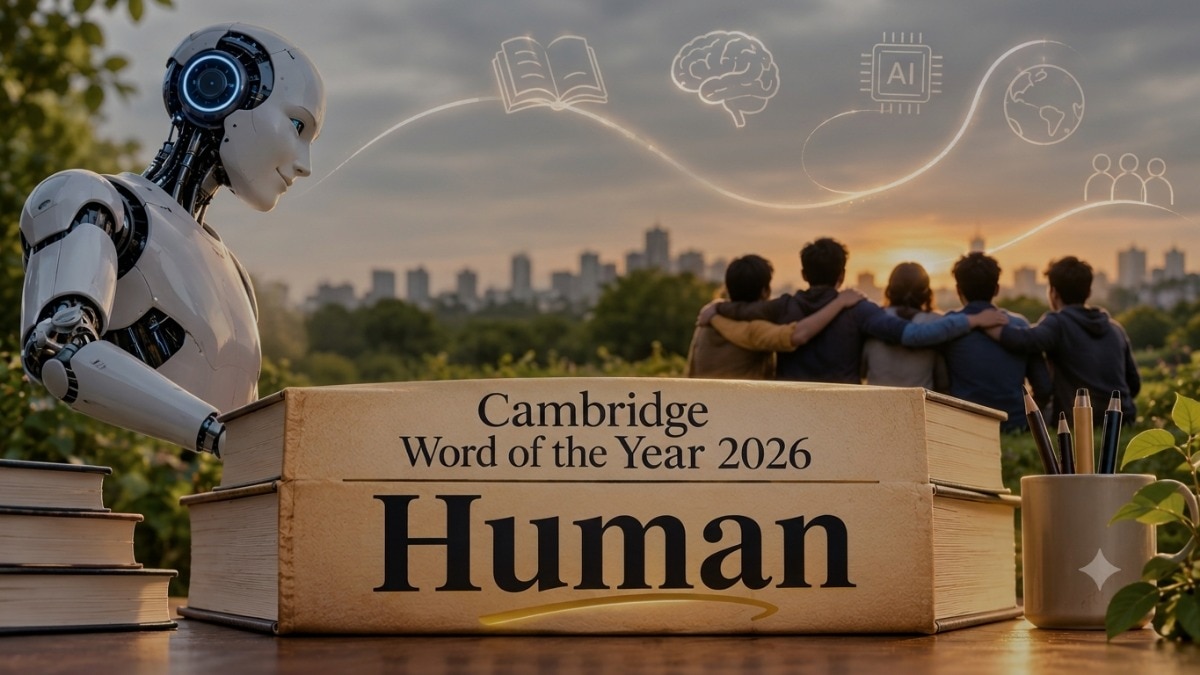
In a historic move, the Cambridge Dictionary has declared 'human' its Word of the Year 2026. This selection comes in response to escalating global debates about human identity in the era of artificial intelligence (AI), with AI increasingly blurring the lines between people and machines. The dictionary defines 'human' as a being that possesses qualities, faults, and feelings typically associated with humans, distinct from gods, animals, or machines.
Concerns about AI's impact on jobs, creativity, education, and human relationships have been at the forefront of discussions. Microsoft co-founder Bill Gates advocated for preserving 'human reserved jobs,' including caregiving roles, from automation. Meanwhile, AI experts like Professor Rachel Adams raised questions about human identity and the potential for AI to both deepen existing inequalities and address them.
The debate over humanity expanded beyond technology and employment in 2026. Nobel laureate Geoffrey Hinton warned that AI was creating alien beings, while celebrities like Scarlett Johansson, Cate Blanchett, Billie Eilish, Jodi Picoult, Jonathan Franzen, Matthew McConaughey, and Taylor Swift campaigned against the unauthorized use of human-created content by AI platforms.
In addition to naming 'human' its Word of the Year 2026, the Cambridge Dictionary also added several popular expressions that reflected changing internet culture and social media trends. These included air jail, a method used to discourage unwanted animal behavior; aura farming, the act of cultivating an impressive personality that others admire; and looksmaxxing, the practice of trying to make oneself as physically attractive as possible.
Other contenders for Word of the Year included agent, referring to an AI system that can operate independently; wholesome, describing something that improves life physically, morally, or emotionally; and analogue, referring to activities that do not involve digital technology. The dictionary is also considering three expressions for future inclusion: weather whiplash, meaning sudden shifts between extreme weather conditions; FOBO, or fear of becoming obsolete due to AI; and dusking, the practice of watching daylight turn to darkness for relaxation.
Concerns about AI safety gained attention following the Hugging Face hacking incident and warnings from Anthropic whistleblower Jacob Coxon. The phrase 'P(doom)', referring to the probability of AI destroying humanity, entered mainstream discussions. Celebrities like Scarlett Johansson, Cate Blanchett, Billie Eilish, Jodi Picoult, Jonathan Franzen, Matthew McConaughey, and Taylor Swift took steps to trademark their voices and images against unauthorized digital reproduction.
The debate over humanity extended beyond technology and employment in 2026. Nobel laureate Geoffrey Hinton warned, "We're creating alien beings. I'm willing to be selfish and choose humans." The selection of 'human' as the Word of the Year 2026 reflects a central question of the AI era: as machines become more capable, how much value will people continue to place on human judgement, empathy, creativity, and connection?